The Future of Agentic AI Might Start in Your Shared Inbox
IBM's blueprint for agentic operations shows why the next phase of enterprise AI is about workflows, orchestration and human oversight, not another chatbot.

A lot of the conversation around agentic AI starts with agents.
I think that may be the wrong place to start.
IBM recently published The Blueprint for Agentic Operations — How to Build an Interconnected Enterprise, based on research with 2,000 senior executives and decision makers across 16 countries and 17 industries.
The report describes a fundamental shift in how enterprises could operate. AI is moving beyond assistants that wait for someone to ask a question. Instead, agents become part of operational workflows, executing routine work across systems while people focus on judgment, exceptions and oversight.
One sentence in the report stood out to me:
"The workflow — not the department or function — becomes the primary unit of value creation."
That is a much bigger change than adding a chatbot to every department.
And strangely enough, I think one of the most practical places to start this transformation is somewhere much less exciting.
The shared inbox.
An email is often not really an email
Consider an email arriving at a shared mailbox:
Where is order 12345? It was supposed to arrive yesterday and if we don't receive it tomorrow our production line will stop.
An AI email assistant sees a message that needs an answer.
An operational AI system should see much more.
There is a customer to identify. An order number to extract. An ERP record to retrieve. A delivery status to check. Urgency to determine. Business impact to understand. A responsible team to identify. Customer history to consider. Perhaps an SLA to verify. And finally, an appropriate response to prepare or an escalation to trigger.
The email is simply the interface through which the business process entered the company.
That distinction is important.
Shared mailboxes such as sales@, support@, shipping@, claims@, accounting@ or reservations@ aren't just communication channels. They are entry points into operational workflows.
From AI assistant to operational workflow
For the past few years, much of enterprise generative AI has followed a familiar pattern:
Human asks AI something → AI generates something → human continues the process.
That can save time, but the human remains the orchestration layer.
IBM's vision of agentic operations looks different.
The company identifies an operational event. AI understands the context, retrieves relevant data, determines what needs to happen and executes parts of the workflow. Humans become involved where their judgment is actually required.
That is much closer to:
Business event → AI workflow → systems and data → decision or action → human intervention when needed
This is also the direction we have been taking with ReplyFabric.
An incoming email can be analyzed and categorized. Relevant features can be extracted. Customer or case information can be retrieved. Knowledge can be added. The responsible person can be identified. Priority and sentiment can be determined. A reply can be prepared. Tasks can be routed. Missing information can automatically be requested.
The interesting part isn't any individual AI feature.
It is the orchestration between them.
IBM identifies three foundations
IBM describes three pillars for what it calls the interconnected enterprise:
- workflow architecture
- data interoperability
- enterprise orchestration
I like that framework because it moves the discussion away from models and prompts.
The question isn't whether your company has access to a powerful language model. Almost everyone does.
The question is whether that intelligence can actually operate inside the way your business works.
- Can it understand where a request belongs?
- Can it retrieve the right information?
- Can it work across systems?
- Does it understand what it is allowed to do?
- Can it identify exceptions?
- Does it know when a person needs to become involved?
- And can the entire process be monitored and improved?
That is where enterprise AI becomes much more interesting.
Your ERP remains your ERP
There is another important implication.
Agentic operations don't necessarily require replacing the systems companies already use. Your ERP can remain your ERP. Your CRM can remain your CRM. SharePoint can remain SharePoint. Outlook can remain Outlook.
The missing layer is often the orchestration between communication, data, rules and actions. IBM calls for an enterprise context layer that gives agentic workflows access to consistent information across systems. For ReplyFabric, we approach that problem from the shared mailbox.
An incoming message provides the unstructured context. ReplyFabric can turn that into structured information and combine it with company knowledge, historical context and data retrieved from systems such as a CRM, ERP, database or SharePoint.
Suddenly an email isn't just text anymore. It becomes structured input for a business process.
The human role changes too
One of the parts I particularly like about IBM's model is that it doesn't assume people simply disappear.
IBM distinguishes between AI agents, workflow managers and domain experts.
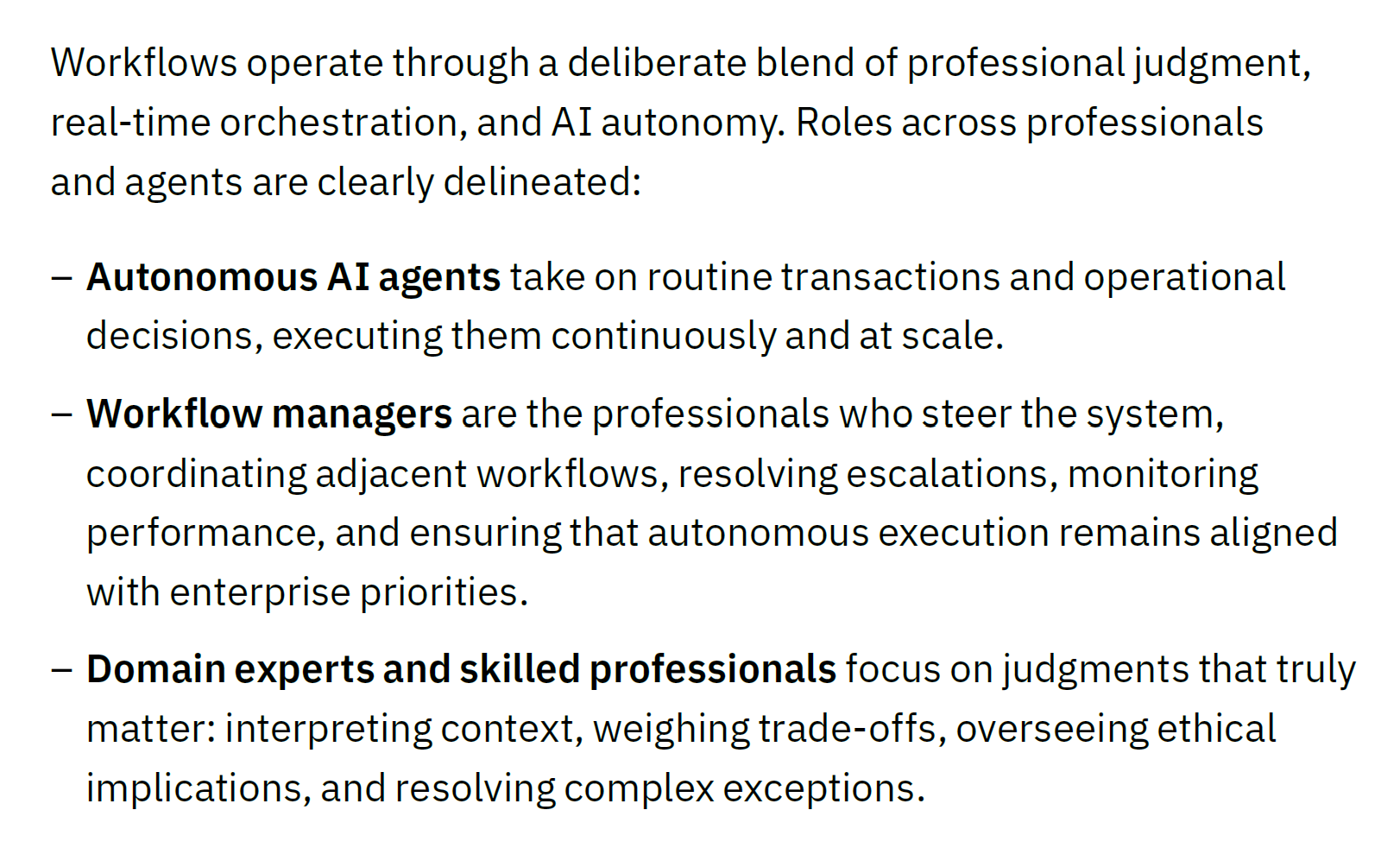
Agents handle routine execution and operational decisions. Workflow managers monitor workflows and deal with escalations. Domain experts concentrate on the situations where context, judgment, ethics or complex trade-offs matter.
That is much closer to how we see AI working in real companies. Take a shared mailbox where a team leader currently spends two hours every morning reading incoming emails and assigning work.
Read. Understand. Categorize. Prioritize. Assign. Repeat.
There is very little value in requiring a highly experienced employee to manually perform those steps hundreds of times. If AI can reduce two hours of workload assignment to five minutes, that person doesn't become irrelevant. Their expertise becomes more relevant. They can concentrate on the difficult cases instead of administrating the easy ones.
This is why human in the loop still matters
There is sometimes an assumption that agentic AI only becomes interesting when everything is completely autonomous.
I don't agree. Autonomy can be introduced gradually.
Today, ReplyFabric can understand an incoming email, retrieve context and prepare a highly informed draft while the employee remains responsible for the final decision. Tomorrow, more deterministic actions can happen automatically. And as confidence, governance and technology mature, the boundary between autonomous execution and human approval can move.
IBM describes exactly this distinction. Routine and data-based decisions can increasingly move to AI, while ambiguous, high-impact and ethical decisions remain with professionals. The goal isn't maximum autonomy. The goal is the right level of autonomy for each workflow.
Governance becomes part of the architecture
This becomes especially important as AI starts taking actions instead of only suggesting them. IBM dedicates significant attention to AI governance and even describes agents monitoring other agents for regulatory compliance, decision accuracy, privacy, risk and policy adherence.
That is a logical next step.
An agent capable of writing a suggested response is one thing. An agent capable of changing an order, making a commitment to a customer, triggering a refund or updating another business system is something else.
The question changes from:
Did the AI produce a good answer?
to:
Is the AI allowed to take this action?
Those are different questions and require different controls.
As enterprise AI becomes increasingly agentic, governance can't be something added after the workflow. It needs to become part of the workflow itself.
The invisible agent may be the most useful one
Another thing I found interesting about IBM's report is how little the future it describes depends on people chatting with AI. That resonates strongly with how we think about ReplyFabric.
There shouldn't necessarily be another interface. There shouldn't always be another prompt. There shouldn't be another dashboard employees have to watch all day.
Sometimes the best AI agent is the one you barely notice.
- An email arrives.
- It is understood.
- It is categorized.
- Relevant information is retrieved.
- The correct workflow is selected.
- The right colleague receives it.
- A draft is waiting.
- And the employee continues working in Outlook.
The underlying technology can become dramatically more sophisticated without making the employee's working environment dramatically more complicated. That matters because IBM's own research identifies change management readiness as the most influential of six foundational capabilities accelerating autonomous workflow adoption. Reducing the amount of change employees experience can therefore be a feature in itself.
Shared inboxes are a surprisingly good place to start
IBM reports that 55% of businesses are already developing or deploying an agentic AI operating model. It also found that 82% of executives believe functional silos block the value autonomy can deliver.
Those numbers are interesting. But the bigger insight for me is architectural. The future of enterprise AI isn't about giving every employee another AI assistant. It's about redesigning workflows so intelligence becomes part of how work moves through the organization.
That doesn't have to start with a multimillion-euro enterprise transformation. Sometimes it starts with an email.
And once that email can be understood, converted into structured information, enriched with business data, connected to the right workflow and routed toward the right human or action, the shared inbox becomes something very different.
Email becomes the entry point into agentic operations.
Source: IBM Institute for Business Value, "The Blueprint for Agentic Operations — How to Build an Interconnected Enterprise", May 2026.
Frequently Asked Questions

About the Author
Tom Vanderbauwhede is the founder & CEO of ReplyFabric, lecturer in AI at KdG University, and a seasoned entrepreneur with 25+ years of business experience. He holds master's degrees in Applied Economics, Business Administration (MBA), and Strategic Change Management & Leadership. Tom is passionate about building AI tools that reduce email overload and help teams focus on what matters.
Connect with Tom on LinkedIn and follow his journey as a founder.